Try things out
Practice and in-game currency tables
These tables are for getting familiar with the game, experimenting and relaxed play. Results do not count towards the regular league or competition rankings.
 New update
Since 2004• Real players• DDV rules
Playing & tables
Whether you want a relaxed practice game, an open table or a private game with friends, this guide helps you choose a suitable table.
Table descriptions help you understand the kind of game on offer before you join.
Try things out
These tables are for getting familiar with the game, experimenting and relaxed play. Results do not count towards the regular league or competition rankings.
Open to other players
Other players can find and join empty seats. Check the table type and settings before sitting down.
Private game
The table host decides who may join. This lets clubs, regular groups and friends play with their chosen company.
Fixed scoring rules
The league, Dodge, Liste Cup and tournaments have fixed rules. See each competition’s own section for details.
Explore competitionsFriends tables combine a private group with a choice of table modes.
The table host approves new guests. Other players can spectate or wait for their turn to play.
Players can change between games. Rotation seats allow regular breaks without breaking up the group.
A fixed group plays a Liste: a series with a chosen number of game rounds and, if enabled, compulsory solo rounds.
With “Open cards” enabled, players who are sitting out can see the active players’ cards.
You need a league-player account to create a friends table. Invited players can also join with a standard-player account.
In-game currency rules for friends tables and Liste sessions
The layout may vary with your screen size, but the steps remain the same.
Open the game client and log in with the account that will host the table.
Open the table overview and choose the option to create a new table.
Choose individual games, table points or a private Liste, and enable the friends-table option.
Give your group the host’s player name or the table number shown in the client.
Approve arriving players, take your seats and mark yourselves ready.
The dealer marks the rotation around the table. The game deals the cards automatically. The opening lead is the first card played to the first trick.
Normally, the player following the dealer in the direction of play has the opening lead. This position is called forehand. The dealer and the opening leader are therefore different roles. A compulsory solo can change who leads. For each later trick, the winner of the previous trick leads.
When a new group starts, seats are assigned first. Unless the table has a specific assignment, they are drawn at random: seat 1 is the dealer and seat 2 has the opening lead. The dealer and opening lead then move on with each game. When someone leaves, the remaining players move closer to their next opening lead; newcomers join at the end of this order. If fewer than three players remain at the table, seats are assigned anew for the next full group.
When seats are reassigned, the league uses each player’s opening-lead rate for the current month: the proportion of their league games in which they had the opening lead. The player with the lowest rate leads first, while the player with the highest rate becomes the dealer. The opening lead then rotates as usual. Seats are therefore not drawn anew after every game.
A Liste is a series played by a fixed group over an agreed number of rounds. Seats are drawn once at the start or assigned according to the table’s rules. The dealer and opening lead then follow the scheduled rotation. In a compulsory solo, the soloist leads; the dealer stays the same for the next game so that the regular opening lead is not skipped.
In Dodge, the cards and dealer are predetermined for each game. Players keep their chosen seats. The dealer is therefore neither drawn anew nor simply moved one seat on after each game.
If you want to leave the table, please wait for your own opening lead and finish that game. This gives the players following you their turn to lead too. At tables with rotation, a waiting player can then take over.
Opening-lead rate and other league rulesThe table host manages the settings available at the table. Their options and how the role passes to another player depend on the table type.
Table info shows the table’s settings and the controls available to you. Depending on the table type, the host may be able to call computer players, restrict table chat or choose game options. Competition tables retain their fixed rules.
At tables where the host is selected automatically, the role goes to the player who has been in the room longest and is playing or waiting in a rotation seat. They keep the role while they remain involved in this way. Otherwise, the next eligible player takes over; simply spectating is not enough at these tables.
The person who creates a friends table is its initial host. They retain the role while in the room, even when spectating. They can manage entry and the game options offered at the table. Hosting a friends table requires a league-player account.
If other players remain in the room, the previous host normally has five minutes to return. After that, the eligible league player who has been in the room longest takes over. If there is no successor, the table closes. A completely empty table may close sooner. Manually managed tournament tables have their own arrangements; system messages announce the relevant changes.
Create a friends tableTwo additional settings are available at certain tables and in tournaments that explicitly announce them.
The deck contains 40 cards instead of 48. In German, this variant is often called “scharfer Doppelkopf”.
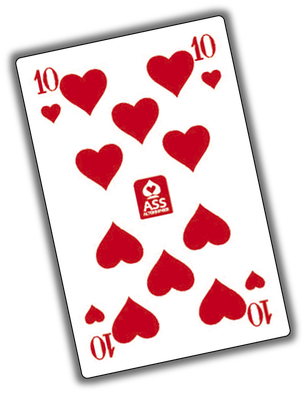
If both tens of hearts are played in the same trick, the second Dulle wins instead of the first. This is a variation on the standard rule.
In tournaments, these rules apply only when shown in the tournament overview and details; they then apply at every tournament table. The league, Dodge and Liste Cup retain their respective competition rules.